The World’s Largest Cloud Infrastructure Providers
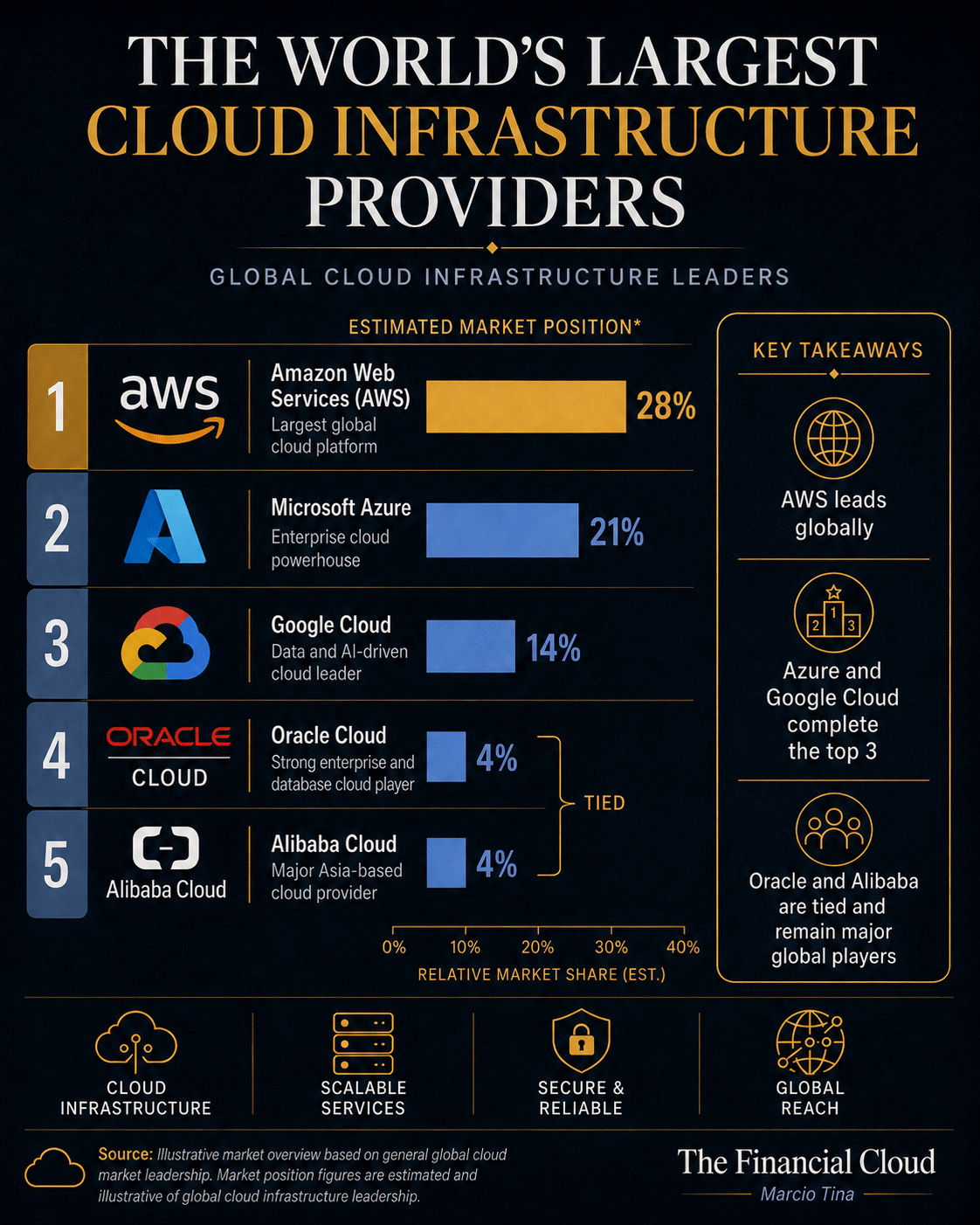
Cloud infrastructure supports some of the world’s most critical digital services. This infographic highlights the leading providers shaping security, resilience, AI and modern financial services.
Full article
The World’s Largest Cloud Infrastructure Providers
Cloud infrastructure has become one of the foundations of the modern digital economy.
Banks, businesses and AI systems increasingly depend on cloud platforms for computing power, data storage, cybersecurity, analytics and operational resilience. Behind much of this infrastructure is a relatively small group of global technology companies.
Together, these companies provide much of the digital infrastructure that allows organisations to operate securely, scale internationally and develop increasingly sophisticated data and Artificial Intelligence (AI) capabilities.
The market leaders
AWS
AWS remains the global leader, offering a broad range of computing, storage, database, networking, security and AI services.
Its scale and global infrastructure make it particularly important for organisations that require high availability, resilience and the ability to operate across multiple regions.
Microsoft Azure
Azure benefits from Microsoft’s long-standing presence inside large organisations.
For companies already using Microsoft technologies for identity, productivity, databases and enterprise applications, Azure provides a natural path into cloud infrastructure.
Google Cloud
Google Cloud has developed a particularly strong position around data, analytics and Artificial Intelligence (AI).
As organisations increasingly combine large datasets with advanced AI models, these capabilities are becoming an important competitive advantage.
Oracle Cloud
Oracle Cloud represents a smaller part of the overall market but remains highly relevant for companies dependent on Oracle databases and enterprise systems.
Its strength is particularly visible in complex and business-critical corporate environments.
Alibaba Cloud
Alibaba Cloud is one of the most important cloud providers in Asia, with a particularly strong presence in China.
For organisations operating across Asian markets, regional infrastructure, local regulation and data-residency requirements can make Alibaba Cloud strategically important.
Why cloud infrastructure matters
The largest cloud providers are no longer simply companies that host websites.
Their infrastructure supports critical services across banking, financial markets, healthcare, government, technology and many other industries.
Security
Cloud providers invest heavily in physical security, encryption, identity management, network protection and cybersecurity monitoring.
However, cloud security remains a shared responsibility. Providers protect the underlying infrastructure, while customers remain responsible for areas such as their data, applications, permissions and configurations.
Resilience
Cloud platforms allow organisations to distribute systems across different infrastructure locations.
This can reduce dependence on a single data centre and improve recovery when failures occur.
For financial institutions, resilience is particularly important because interruptions can affect payments, trading systems, customer access and other critical operations.
Artificial Intelligence
AI is becoming one of the strongest drivers of cloud adoption.
Advanced AI systems require enormous amounts of computing capacity, specialist hardware, storage and high-speed networking. Cloud platforms allow organisations to access these capabilities without having to build the underlying infrastructure themselves.
Compliance
For regulated industries, cloud adoption also introduces questions around governance, data protection, operational resilience and third-party risk.
Financial institutions need to understand where information is stored, who can access it and how critical services recover from disruption.
Cloud infrastructure is therefore increasingly relevant not only to technology departments, but also to risk, compliance and regulatory teams.
More than a technology competition
Choosing a cloud provider involves much more than selecting the largest company.
Organisations must consider security, regulation, geographic coverage, resilience, cost, existing technology and future requirements for data and AI.
What is increasingly clear is that AWS, Microsoft Azure, Google Cloud, Oracle Cloud and Alibaba Cloud provide much of the infrastructure behind the modern digital economy.
As financial services become more digital and AI adoption accelerates, understanding the cloud will become increasingly important — not only for technology professionals, but for anyone working across financial markets, risk and modern compliance.